

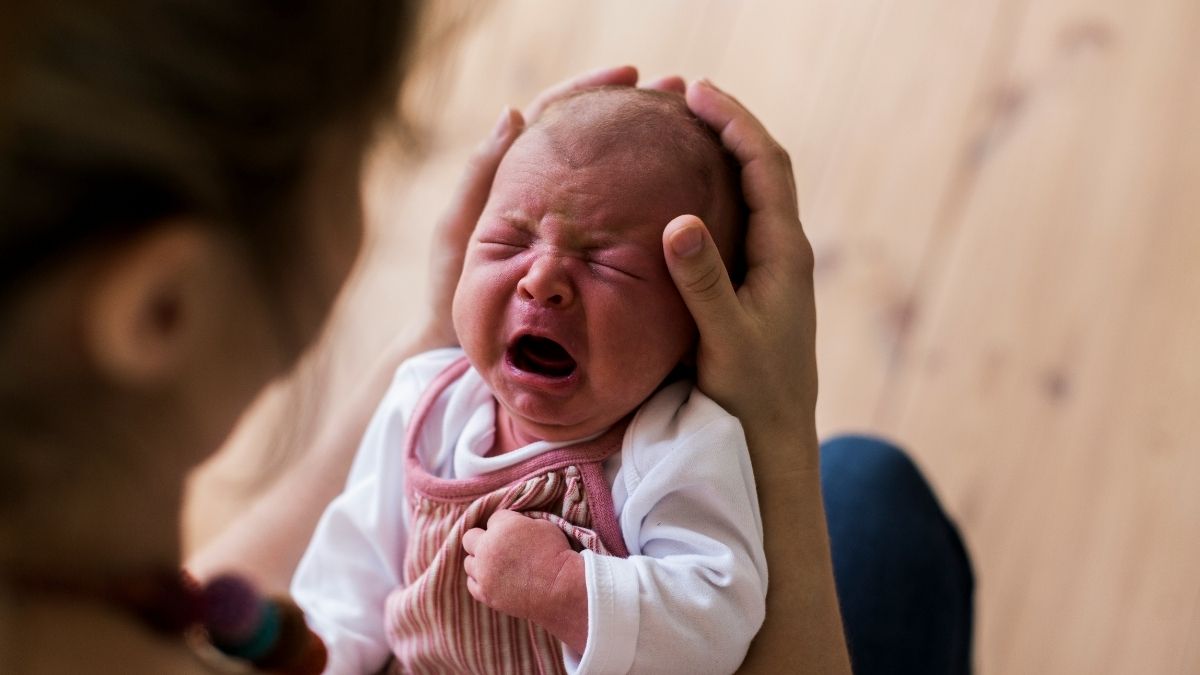

With three kids, I have heard a lot of crying. I was lucky never to deal with true colic, but that did not mean I understood every cry right away.
It took time, and a fair amount of trial and error, to learn that crying is not a problem to solve as fast as possible. It is a message. Once I started listening to what each cry was actually telling me, everything got a little easier, even on the hard days.
Why Do Babies Cry?
Babies cry because it is the only language they have. A newborn cannot tell you they are hungry, overtired, too warm, or simply overwhelmed by the world, so crying is how they ask for help. This is common in the early months, and it is not a sign that something is wrong with your baby or with your parenting.
Crying tends to be more frequent in the first few months of life, often heavier in the evening hours, and it typically eases as babies grow and find other ways to communicate. If you are deep in those early weeks right now, our guide on the newborn phase covers what to expect as things gradually get easier.

Common Newborn Crying Patterns
It is often heaviest in the evening
Many parents notice their baby seems fussier in the late afternoon and evening, sometimes called the witching hour. This is a common and temporary pattern in the newborn stage rather than a sign that something is wrong.
Crying does not always mean your baby is fully awake
One thing that surprised me with all three of mine is that babies can cry out briefly during sleep and then settle right back down without ever really waking up. If you rush in at the very first sound, you may end up waking a baby who would otherwise have drifted back off on their own. It takes practice to tell the difference, but giving it a moment before responding is often worth it.
The Trap of "Don't Cry"
One of the things I see so often, and something I fell into myself in the early days, is the instinct to say "don't cry" the moment a baby starts fussing. It comes from a good place.
We want our babies happy again as fast as possible. But the more useful question is not how to stop the crying. It is why the baby is crying in the first place, and how to support them through the feeling rather than around it.
Babies are born without the ability to calm themselves the way adults can. They need to borrow our nervous system until theirs matures. I took a Circle of Security course, and one thing that stuck with me is how early children start learning which feelings are acceptable to show and which are not.
That is exactly why meeting a baby's cry with calm, rather than frustration, matters so much, even when staying calm is genuinely hard in the moment. A frustrated baby does not need a frustrated adult. Babies pick up on our stress and tension more than we realize, and they adjust their own state in response to ours.
A note on "crying it out"
This is part of why I don't recommend letting a baby cry alone and unattended until they stop on their own. In a 2012 study published in Early Human Development, researchers followed babies through a sleep training program in which crying went unanswered.
By the third day, the babies had stopped crying, and their mothers' cortisol dropped along with it, since there was no longer a distress signal to respond to. But the babies' own cortisol levels stayed elevated. Their bodies were still registering stress, even though the outward sign of it had gone quiet.
This doesn't mean every approach to sleep involves ignoring your baby. There is a wide range of gentler settling methods between letting a baby cry it out alone and never working on sleep habits at all. What matters most to me is presence. You can help your baby learn to settle without disappearing on them when they're upset.
Practical Tips for Responding to Crying
Motion is one of your best tools
For newborns especially, movement is often the fastest way to soothe a cry that will not settle with feeding or a diaper change alone. This was true for all three of my kids.
That is a big part of why we leaned on rocking so heavily, whether that meant walking laps around the kitchen island at 2 a.m. or, once we had our Sleepytroll, letting it keep the stroller gently moving during a nap. We had it from day one with my daughter, and from when my second son was almost one.
If you want to understand the science behind why motion works so well, our guide on why rocking helps your baby sleep goes into the details.
Rule out the basics first
Hunger, a wet diaper, being too hot or too cold, and overtiredness are the most common culprits behind newborn crying. Working through these calmly, one at a time, is usually more effective than panicking and trying everything at once.
Nursing can soothe more than just hunger
With all three of mine, nursing was one of the fastest ways to calm a hard cry, even outside of regular feeding times. Comfort nursing is a completely normal and valid tool, not something you are doing wrong just because your baby may not be hungry. If you are formula feeding or combination feeding, offering a bottle can also help soothe through sucking and closeness, even if it works a little differently than nursing does.
Skin-to-skin contact calms on its own
Close body contact, with or without feeding involved, is one of the simplest ways to settle a crying baby. Holding your baby against your bare chest, or simply keeping them held close against your body, helps regulate their breathing and heart rate and reminds them of the closeness they had in the womb. This is not just a nice extra either.
Kangaroo care, which is essentially structured skin-to-skin contact, is actively used in NICUs for newborns and premature babies specifically because of how effectively it calms and stabilizes them. It works alongside motion and feeding, but it is also worth using on its own, especially in moments when your baby just needs to feel your body near theirs.

With older babies, validate rather than distract
As my kids grew past the newborn stage, the tools shifted from pure motion to more emotional support. Naming the feeling, staying physically close, and letting them know it is okay to be upset went a lot further than trying to quickly redirect their attention.
It Is Okay to Need a Break Too
Some cries are genuinely hard to sit with, especially if you are exhausted, alone, and the crying has gone on for a while. If you ever notice your own frustration building to a point where you feel like you might shake or handle your baby roughly, that is your cue to act, not a sign of failure.
Place your baby down somewhere safe, such as their crib or bassinet, and step into another room for a few minutes. Take some breaths, let your own nervous system settle, and then go back.
Ask for help if you can. Reaching out to a partner, family member, or friend to take over for a bit is not a sign that you cannot handle things. Needing a break does not make you a bad parent. It makes you a safe one.
When to Call the Doctor
Most crying is completely normal and part of newborn adjustment, but there are times to check in with your pediatrician. Reach out if your baby's cry sounds different than usual, such as unusually high-pitched or weak, if crying is paired with a fever, if your baby seems inconsolable for hours at a time, or if you notice a change in feeding or breathing along with the crying.
Trust your instincts here. You know your baby's normal better than anyone. Our guide on common newborn problems can help you sort out what is typical from what is worth a call.
FAQ: Why Babies Cry
Is it okay to let a baby cry it out?
Crying it out means leaving a baby to cry alone and unattended until they stop on their own, and I don't recommend it. Crying is your baby's language before they have any other way to tell you something is wrong, and staying close and responding to that language isn't something I believe in phasing out.
There is research behind this too. A 2012 study found that when babies stopped crying during sleep training, their cortisol, a stress hormone, stayed elevated even though the outward sign of distress had gone quiet. Their bodies were still registering stress.
Why does my baby cry more in the evening?
Many babies go through a period of increased evening fussiness in the first few months, sometimes called the witching hour. It typically eases as babies get a bit older.
How long does newborn crying usually last?
Crying is typically most frequent in the early months and tends to decrease as babies develop other ways to communicate and self-soothe, usually easing noticeably by three to four months.
Can babies cry while they are still asleep?
Yes. Babies sometimes cry briefly during sleep cycles without fully waking up, then settle back down on their own. Waiting a moment before rushing in can help you avoid accidentally waking a baby who was about to resettle.
When should I worry about my baby's crying?
Contact your pediatrician if the cry sounds unusual, is paired with fever or feeding changes, or if your baby seems inconsolable for an extended period. When in doubt, it is always worth the call.
Crying can feel overwhelming in the moment, but it is your baby's way of asking for exactly what they need, and learning to listen to it is one of the most useful parenting skills you will build.
Explore how Sleepytroll can help bring calm back to the hardest moments of the day.